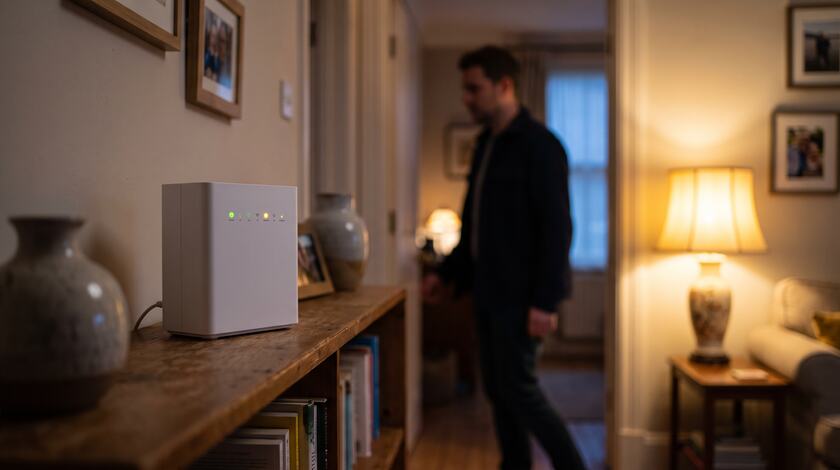
Comcast on Tuesday launched Xfinity Shield, a home protection package that leans heavily on something its gateways can already do: sense when a person moves through a room by watching how WiFi signals change. The feature, called WiFi Motion, is now bundled at no extra charge for Xfinity Internet customers with a compatible gateway. It needs no cameras or dedicated sensors, which is the selling point, and also the reason the terms attached to it deserve a careful read.
The free tier is called WiFi Shield. Alongside motion sensing it includes Comcast's network protection against malware and phishing, parental controls, and three modes that decide when alerts are sent: one for when people are home and awake, one for an empty house, and one for overnight. A paid tier, Shield Select, costs $15 a month. For that, customers get a camera for indoor use and a sensor for a door or window, with video kept in the cloud, plus a button that summons emergency help around the clock.
How a router senses movement
WiFi Motion treats the radio link between the gateway and a stationary device, a smart speaker or a thermostat for instance, as an invisible tripwire. A customer picks up to five such devices around the home. When a body passes through the space between one of them and the gateway, it disturbs the signal in a measurable way, and the Xfinity app sends a notification.
Comcast says the system detects that something moved, not who it was or exactly where they were standing. It records no video, images or audio. Sensitivity can be adjusted, and there is a setting that tries to ignore pets of about 40 pounds or less. The company is frank about the limits of that: with no picture to go on, the system cannot reliably tell a small dog from a small child. People in apartments are advised to turn the sensitivity down, because a neighbor moving on the other side of a shared wall can set it off.
None of the underlying technology is new. Comcast has offered WiFi Motion to some customers since at least last year, and the general technique of reading movement from WiFi signals has been studied for much longer. What changed this week is that it has been moved to the center of a security product and put in front of every eligible subscriber.
Who else can see the data
The feature is opt in and switched off by default. Comcast's own position is that nobody at the company looks at the motion events or the alerts the service produces.
The support documentation adds a condition, though. It says Comcast may pass information produced by WiFi Motion to third parties without telling the customer again. The situations it lists are police investigations and court proceedings, disputes the company itself is a party to, and subpoenas or court orders.
That clause is worth thinking through before switching the feature on. A log of motion events is a record of when a home is occupied, when its residents get up and go to bed, and when the house is empty. Camera footage from a doorbell raises the same questions, but most people understand what a camera sees. A router that quietly notes movement in the living room is less obvious, including to guests and other members of the household who never agreed to it.
The documentation does not say what motion information Comcast keeps on its own systems, or for how long. Without that, customers cannot judge what could actually be handed over in response to a legal demand. A feature that only produced alerts on the customer's phone and stored nothing would carry little risk. One that keeps a history on the provider's servers is a different proposition.
Comcast says more features will be added to Xfinity Shield next year. For now, subscribers who like the idea of motion alerts without cameras can have them for free, and those who would rather not generate the data at all can simply leave the setting off.